
Tree service companies get leads three ways: buy them from a platform, pay for ad placement, or build a presence that produces calls without a per-lead invoice. The first two work immediately and stop the day the budget stops. The third takes a few months to ramp and then keeps producing. Most tree service owners run entirely on the first two and wonder why the phone goes quiet every January.
The fix is not more spend. It is knowing which of those three is actually booking jobs, and building the one that compounds while the other two carry the cash flow.
What a tree service lead actually costs in 2026
Start with the numbers, because most owners are working off a gut feel that is two years stale.
Google Local Services Ads are the cleanest paid channel — you pay per lead, not per click. As of September 2026, the average charged LSA lead for tree services runs $53.01, with a median of $56.58 and most landing between $42.51 and $82.98. That figure comes from a small sample of campaigns, so treat it as a planning range rather than a promise. One note for anyone budgeting past this quarter: Google began migrating LSAs into Performance Max with pay-per-lead goals in August 2026 for select home service categories. The placement and the pay-per-lead model stay the same. The dashboard and the manual bidding do not.
Standard Google Ads run higher for tree work — roughly $85 to $110 per lead in an average market — because tree service clicks are expensive and you pay for every one whether they call or not.
Shared marketplaces are where the math gets ugly. Angi leads run $15 to $85, plus around $300 a year for access, and the same homeowner request goes to three to eight contractors at once. A $30 lead sounds cheaper than a $53 one right up until you find out four competitors bought the identical request and the homeowner is now using your bid to negotiate somebody else down.
That is the whole trap. Cost per lead is the wrong number. Cost per booked job is the number, and you cannot calculate it without tracking which source produced each job you actually won.
Your Google Business Profile is the lead source, not your website
For a homeowner with a limb on the roof, the decision happens in the map results. They see three companies, they call one, and most of them never open a website at all.
What decides which three appear is the Google Business Profile itself — categories, listed services, attributes, hours, photos, and review content. For tree service specifically, the category gap is enormous. Most companies set one primary category and stop, leaving Tree Pruning, Stump Grinding, Arborist, and Storm Damage Restoration unclaimed. Every empty category is a search the company cannot appear for, no matter how good the crews are.
This matters more in 2026 than it did in 2024, because AI assistants answering local questions read profile data rather than browsing websites. A thin profile does not rank lower in those answers. It often doesn’t appear at all.
The five gaps that suppress contractor profiles covers the audit in full. For tree service, start with categories and services, because those two fields cap everything downstream.
Reviews are the close, and velocity beats total count
Tree work carries real property risk. A homeowner authorizing a crew with chainsaws to work over their roof is making a trust decision before a price decision, and the review profile is the only evidence available at that moment.
Two things matter more than total count. The first is recency — a company with 40 reviews arriving steadily beats one with 90 that stopped a year ago. The second is content. Reviews that name the actual service, the timing, and the town function as structured data even without markup. “They took down a dead oak leaning over our garage two days after the storm” tells Google and every AI assistant far more than “great service, highly recommend.”
The system is simple and almost nobody runs it: ask at job close while the customer is standing there looking at the cleanup, text the direct review link within minutes, follow up once at 48 hours, and respond to every review that lands. The full review system is here.
Storm demand rewards preparation, not reaction
Every tree service company gets the storm spike. The ones who capture it aren’t the ones who react fastest when the wind stops — they are the ones whose emergency and storm damage pages were already indexed and whose profiles already listed emergency service before the forecast changed.
You cannot build that page during the storm. It will not rank in time. Build the emergency removal and storm damage pages in the slow season, keep them current, and let them sit there waiting. When the demand arrives, you are already in the results while your competitors are writing copy.
Commercial and property manager work is what ends the seasonality problem
Residential removals are lumpy and weather-driven. Commercial contracts, HOA accounts, and property management relationships are the opposite — scheduled, recurring, and largely indifferent to whether the season was stormy.
This is a different sales motion. Property managers do not search “tree removal near me” at midnight. They shortlist vendors, check insurance and certifications, and want a single contact who returns calls. Winning that work takes a page that speaks to commercial buyers, credentials that are visible and easy to verify, and direct outreach to property management firms in the service radius. The tree service industry page covers how to build that positioning alongside the residential side.
The shared-lead trap, in one paragraph
Buying shared leads means competing on speed and price for a homeowner who has four other quotes coming. Close rates on shared leads sit far below exclusive ones, which means the cheaper per-lead price frequently produces a higher cost per booked job. Shared leads work as a short-term fill while you build something else. They don’t work as the foundation, and companies that build a business on them are renting a pipeline the platform can reprice at any time. The full breakdown of why contractors are moving off these platforms applies directly to tree service.
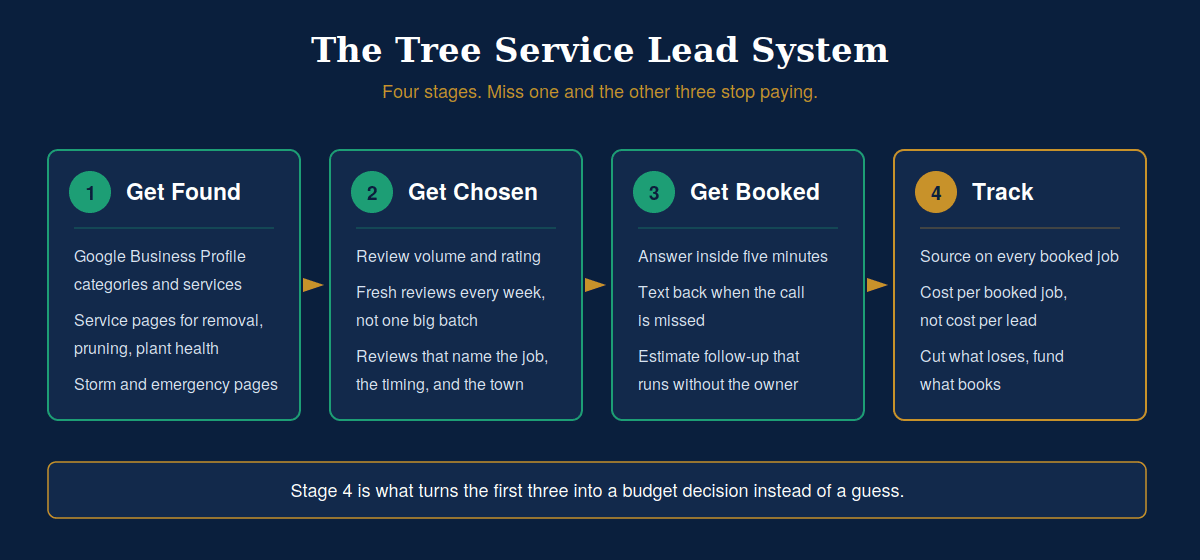
Answer the phone in five minutes or stop paying for leads
This is the cheapest fix in tree service marketing, and the one most companies skip.
Leads contacted within five minutes are roughly 21 times more likely to qualify than leads contacted at 30 minutes, per the Lead Response Management study that tracked more than 15,000 leads. In tree service, the effect is even sharper, because emergency calls don’t wait — a homeowner with a split trunk over the driveway calls the next company on the list in about four minutes.
Crews are in the field and cannot answer. That is not an excuse, it is a system requirement: missed-call text-back, an answering service that takes real job details, and an estimate follow-up sequence that runs without the owner remembering. A company spending $2,000 a month on leads and answering in four hours is burning most of that money.
Track the source or none of this is a decision
Here is the discipline that separates the tree service companies that scale from the ones that keep guessing: record a source for every booked job. Not every lead — every booked job.
Do it for 90 days, and the budget question answers itself. You will find one channel producing jobs at half the cost of another, and at least one line item producing almost nothing while quietly billing every month. Without that record, marketing spend is a feeling. With it, it is arithmetic.
What this looks like when it compounds
Elena Patrice spent nearly 12 years as the in-house marketing and business development lead for a tree care company that grew from roughly $400K to $6M+ in revenue and from 3 to 49 employees, running paid media up to $20K a month across Google Ads, Yelp, and Meta alongside the organic and profile work. That growth reflected many factors — crews, operations, leadership, and market conditions — and marketing was one contributor, not the cause. The full case study is here.
The transferable part is the sequence. Paid channels carried cash flow while profile, reviews, and service pages were built underneath. Once the owned side produced consistently, paid became a lever for slow weeks and storm response, not the whole pipeline.
Start here
If the phone is slower than it should be, the constraint is almost always one of four things: the profile is thin, reviews have gone stale, response time is too slow, or nobody knows which channel is producing. Fix them in that order.
Find out where your tree service actually stands
The Pinned Local diagnostic scores your Google Business Profile and local search presence across five phases in about five minutes, then returns your score and ranked priority actions. No credit card and no sales call.
Frequently Asked Questions
How much does a tree service lead cost in 2026?
A tree service lead costs roughly $53 through Google Local Services Ads, $85 to $110 through standard Google Ads, and $15 to $85 through shared marketplaces like Angi. The LSA figure averages charged leads as of September 2026, with most falling between $42.51 and $82.98, based on a small sample of campaigns. Shared marketplace leads look cheapest per lead but are sold to three to eight contractors at once, which pushes the real cost per booked job well above the exclusive channels.
How fast do I need to call back a tree service lead?
Within five minutes. Leads contacted within five minutes are roughly 21 times more likely to qualify than leads contacted at 30 minutes, according to the Lead Response Management study of more than 15,000 leads. Emergency tree calls move faster still, because a homeowner with a damaged tree over the driveway will work down the list until somebody picks up. Missed-call text-back and an answering service that captures real job details cost less than a week of ad spend and recover more revenue.
How do tree service companies get leads in the winter?
Winter lead flow comes from work that isn’t weather-driven: structural pruning, hazard and risk assessments, plant health care, and commercial or HOA contracts scheduled in advance. Social Status builds service pages and profile categories for those searches during the slow season so they are indexed and ranking before the demand arrives. Companies that market only removal and storm cleanup have an intentionally seasonal pipeline, and the fix is adding the year-round services to the site and the Google Business Profile rather than increasing spend in January.
How do I know which marketing channel is actually booking my tree jobs?
Record the source of every booked job — not every lead, every booked job — for 90 days, then divide each channel’s spend by the jobs it produced. That gives cost per booked job, which is the only number that supports a budget decision; cost per lead hides the close-rate difference between exclusive and shared sources. Most tree service companies running this for the first time find one channel producing jobs at half the cost of another, plus at least one line item billing monthly and producing almost nothing. Social Status sets this tracking up before recommending any change in spend, because without it every recommendation is a guess.
Written by Elena Patrice — Founder and President of Social Status Inc. Since 2018, building local search visibility and growth systems for trades and service businesses ready to scale. Learn more →