
Most roofing companies don’t have a lead problem.
They have a source problem.
Buying Angi or HomeAdvisor leads puts you in a race you don’t control.
There’s a better way — one that builds consistent, exclusive, high-intent leads directly from your market. It’s the same approach behind roofing contractor marketing that produces owned lead flow instead of rented access.
Why Angi and HomeAdvisor Stop Working
Lead platforms are not built for your growth. They’re built for volume.
What that means for you:
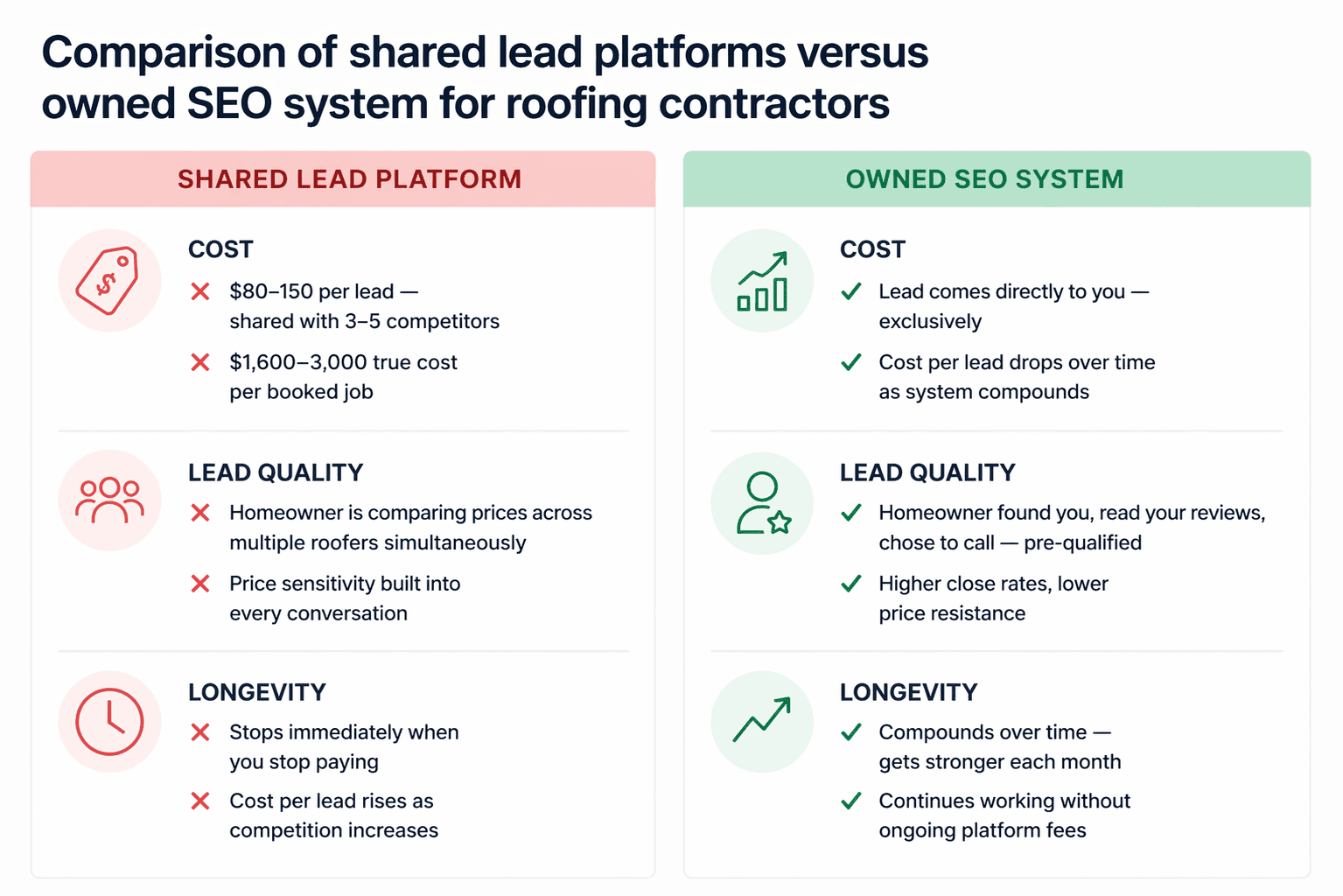
• Your lead is sold to 3–5 competitors at the same time
• Speed matters more than quality
• Homeowners are comparing—not committing
• Your margins get squeezed before you even quote
Even when you “win,” you’re paying for access—not ownership.
The Real Cost of Shared Leads
On paper, the numbers look fine.
In practice:
• Low close rates — shared leads convert at a fraction of the rate exclusive ones do
• Hours spent chasing unqualified prospects
• Brand damage from price-shopping conversations
You’re not building a pipeline.
You’re renting attention.
What Actually Works Instead
The companies pulling ahead are doing one thing differently:
They control their lead flow.
That comes from:
- Ranking in Google, both organic and Maps
- A site built to convert, not just exist
- A Google Business Profile optimized to drive calls
- Consistent visibility in your service area
This is how Angi and HomeAdvisor get leads.
You can do the same—locally.
The Local SEO Foundation Every Roofing Company Needs
Local SEO for roofing contractors is what determines whether you show up when homeowners search in your service area.
That visibility comes from how you build and structure your service areas across your site.
For roofing companies, local SEO connects your website, Google Business Profile, reviews, and service-area content into one visibility system.
When those signals line up, Google has a clearer reason to show your business for searches tied to roof repair, roof replacement, emergency roofing, and city-level contractor searches.
Where Roofing Jobs Actually Come From (In Your Local Market)
Most roofing jobs don’t come from national platforms.
They come from homeowners searching in their immediate area.
“Roof repair near me”
“Roofing company in [city]”
“Emergency roofer [location]”
If your business isn’t showing up in those moments, you’re invisible—regardless of how many leads you buy.
This is where local visibility becomes everything.
Most roofing companies miss this.
They focus on getting leads instead of showing up where decisions are made.
That shift—from chasing leads to owning visibility—is what separates consistent companies from inconsistent ones.
The Shift: From Buying Leads to Owning Them
Instead of paying per opportunity, you build an asset.
What changes:
• You show up when homeowners search
• You get the call first—not fifth
• You compete on trust—not price
• Your cost per lead drops over time
This is where growth actually happens.
What Your Roofing Website Should Be Doing
Most contractor sites fail here.
They look fine—but don’t generate anything.
Your site should:
- Target real search terms in your service area
- Answer exactly what homeowners are searching
- Make it easy to take action (call, form, quote)
- Support your Google Business Profile
A roofing website should not read like a brochure. It should help homeowners understand the service, trust the company, and take the next step without friction. If it’s not doing that, it’s not working.
How to Start Fixing This
You don’t need to rebuild everything at once.
Start here:
• Fix your Google Business Profile (categories, services, photos, reviews)
• Tighten your website structure and service pages
• Create content that matches real searches
• Connect everything—don’t treat them separately
Each piece supports the other.
You Don’t Need More Leads—You Need Better Ones
More volume doesn’t fix a broken system.
Better inputs do.
The goal isn’t traffic.
It’s qualified calls from people ready to move forward.
Your next roofing job isn’t coming from a national platform.
It’s coming from someone searching in your area.
If your roofing business is still relying on shared leads, it’s time to change the model.
A Revenue Map Call shows you exactly where your local visibility stands and what it would take to replace bought leads with owned ones.
Frequently Asked Questions
Why should I stop using Angi or HomeAdvisor?
Because the same lead is sold to three to five contractors at once, turning every opportunity into a race for speed and price. That structure caps your close rate no matter how good your work is, and it means you are paying for access to a homeowner rather than building anything you keep. Social Status treats these platforms as a short-term fill, never a primary source.
Are paid leads ever worth it?
Yes, in two situations: filling a slow stretch while owned channels are still building, and testing a new service area before investing in local visibility there. They should not be the foundation. The moment you stop paying, the leads stop, and you are left with nothing you own.
What is the best long-term lead source for roofers?
Your Google Business Profile and your website working together. The profile gets you into the map pack where homeowners are actually looking, and the site converts the ones who click through. Reviews feed both. Once that system is running, the leads are exclusive, high-intent, and cost close to nothing per additional lead.
How long does it take to replace paid leads?
Early movement usually shows within weeks because profile corrections and review activity don’t depend on ranking. Replacing a meaningful share of paid volume typically takes three to six months. The realistic path is to run both in parallel and shift the mix as owned channels start producing, not switch off paid on day one.
How do I get my roofing company to show up in Google Maps?
Map visibility comes from your Google Business Profile more than your website. That means an accurate primary category, every service listed individually, attributes and hours filled in completely, photos added on a schedule, and a steady flow of recent reviews. A thin profile doesn’t rank lower than a complete one—it often doesn’t appear at all.
What is the difference between SEO leads and paid leads?
SEO leads come from homeowners actively searching for roofing in your area, and they reach you exclusively. Paid marketplace leads are shared with competitors, often lower intent, and require you to win a race before you win the job. The cost difference compounds too: paid leads stay expensive, while organic cost per lead falls as the system matures.
Written by Elena Patrice — Founder and President of Social Status Inc. Since 2018, building local search visibility and growth systems for trades and service businesses ready to scale. Learn more →