
You can spend $2,000 a month on ads. You can hire an SEO agency. You can post on social media every day. None of it will move the needle the way a consistent contractor Google reviews system will — and almost none of it is free.
Reviews are the one marketing asset that compounds. Every new review makes the next lead easier to close. And most contractors are leaving this entirely to chance.
Why Google Reviews Are a Contractor’s Highest-ROI Marketing Move
Google reviews for business are not a vanity metric. They do two things simultaneously that no other marketing channel does: they improve your map pack ranking and they convert the leads you’re already getting. Most marketing either gets you visibility or closes leads. Reviews do both — for free, forever, after a 30-second ask.
Review signals account for roughly 16 to 17% of Google’s local pack ranking weight, per Whitespark’s 2026 Local Search Ranking Factors survey — behind only Google Business Profile signals and on-page signals. And 88% of consumers are more likely to use a business that responds to all reviews, with responding businesses receiving an average of 12% more reviews and a higher average rating. That’s not a marginal gain. That’s a system producing revenue while you’re on a job site.
97% of consumers read reviews for local businesses, and 41% now say they always do — up from 29% a year earlier. Every homeowner who searches for a contractor in your market sees your review count and rating before they ever click your name. That number, and those stars, are doing your selling before you even pick up the phone.
What Your Review Count Is Actually Telling the Market
Your Google review count isn’t just a number. It’s a signal. To Google, it signals trust and activity. To homeowners, it signals experience and reliability. A contractor with 12 reviews and a competitor with 87 aren’t competing on equal footing — they’re in different categories in the homeowner’s mind.
Businesses in the top three local positions consistently carry more reviews than those further down, but the consistency of new reviews arriving matters more than the total. 73% of consumers only pay attention to reviews from the past month. A contractor with 90 reviews and none in six months is losing ground to one with 40 reviews and a steady weekly flow.
Most competitive markets require an average star rating between 4.5 and 4.7 to compete. BrightLocal’s 2026 survey found 31% of consumers will only use businesses rated 4.5 stars or higher — nearly double the 17% who said so in 2025. If you’re sitting at a 4.2 with stale reviews, you’re being filtered out before the first call, not because your work is worse, but because your review profile tells a weaker story.
The Contractor Review System That Actually Works
The contractors dominating their local map pack aren’t getting more reviews because they do better work. They’re getting more reviews because they ask — every time, systematically, at exactly the right moment.
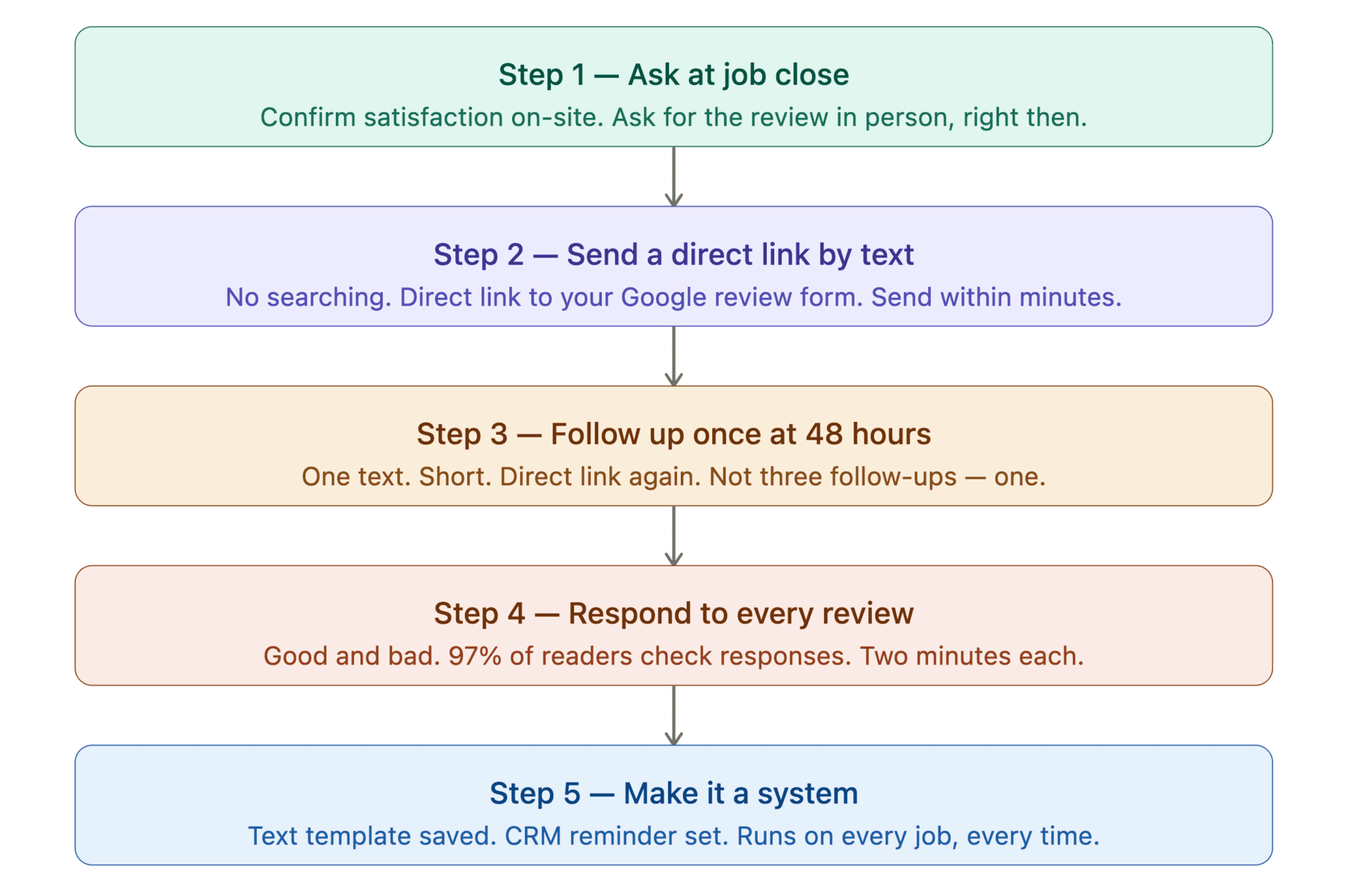
Here’s the system:
Step 1: Ask at job close — not days later
The best moment to ask for a review is the moment a customer expresses satisfaction — at job completion, when they say “looks great” or “thank you.” That’s peak goodwill. Wait 48 hours and the moment has passed. They’re onto the next thing. You’re a memory.
Train every crew member to confirm satisfaction at job close and to tell the customer: “We’d really appreciate a Google review — I’ll send you a link right now.” Then send it immediately by text.
Step 2: Send a direct link — never make them search
The single biggest friction point in review generation is making the customer find your profile. Don’t. Send a direct link to your Google review form. You can get this from your Google Business Profile dashboard — it’s a short URL that takes them straight to the review box.
Every extra click you require loses a percentage of your reviews. A direct link sent within minutes of job completion is the difference between a review that happens and one that was meant to happen.
Step 3: Follow up once — by text
If a customer doesn’t leave a review within 48 hours, send one follow-up text. Keep it short: “Hi [name], just following up — if you have a moment, a Google review would mean a lot to us. Here’s the link: [link].” One follow-up. Not three. Not an email sequence. One text, 48 hours later.
Most customers who are asked will leave a review. Most contractors just never make the ask.
Step 4: Respond to every review — including the bad ones
Owner responses get read. Every response you write is being read by future customers. A thoughtful response to a negative review demonstrates professionalism and accountability — often more effectively than the positive reviews surrounding it.
Responding to reviews also signals to Google that your business is active and engaged. It takes two minutes per review. There is no lower-effort, higher-impact activity in contractor marketing.
Step 5: Make it a system, not a task
The contractors with 150+ reviews didn’t get there by remembering to ask. They built a process — a text template saved on every crew lead’s phone, a follow-up reminder in their CRM, a weekly check on new reviews. When review generation is a system, it happens whether you’re busy or slow, whether the job was big or small.
This is exactly the kind of system Social Status builds inside Growth Systems engagements — because a consistent review pipeline is one of the fastest ways to move up in the map pack and start winning bids you’re currently losing.
What to Do If You Have Very Few Reviews
If you’re starting with fewer than 10 reviews, don’t panic. Start with your most recent satisfied customers — anyone from the last 90 days. Send them the direct review link with a personal note. Then build forward from there with every new job.
Do not ask for reviews in bulk from old customers all at once. Google’s algorithm can flag a sudden spike in reviews as suspicious. Steady velocity — two to five new reviews per week — is what builds lasting map pack position. See how this fits into the broader local SEO system Social Status runs for trades businesses.
Reviews vs. Ads: The Math That Changes the Decision
A Google Ads campaign for a contractor runs roughly $90 to $230 per lead depending on trade — roofing at the high end, HVAC and plumbing lower. A Google review costs nothing and closes leads for years. One five-star review from a satisfied roofing customer doesn’t expire. It sits on your profile and does its work every time a homeowner searches your service area.
Reviews compound. Ads stop the moment you stop paying. For a trades business at $500K–$2M revenue, the highest-leverage marketing decision you can make this month is not a bigger ad budget — it’s a review system that runs every time a job closes.
Your Google Business Profile is the vehicle. Reviews are the engine. Without consistent reviews flowing in, the profile stalls — no matter how well it’s optimized.
How Many Reviews Do You Actually Need?
There’s no universal answer, but here’s a practical framework: audit the top three map pack results in your primary service area right now. Count their reviews. Your target is to match or exceed the lowest of the three. That’s your first milestone.
Once you’re in that range with a 4.5+ rating and fresh reviews arriving weekly, you’re competitive. From there, the gap between you and position one is usually velocity — how consistently new reviews are coming in, not how many you have total.
If you’re not sure where your review profile stands relative to your competitors, a Revenue Map Call shows you exactly where you are, where the gap is, and what it would take to close it.
Your reviews are your highest-ROI marketing asset. Are you building them systematically?
A Revenue Map Call shows you exactly where your review profile stands against your competitors and what to fix first.
Frequently Asked Questions
How do contractors get more Google reviews?
The most effective system is simple: ask at job close, text a direct Google review link within minutes, follow up once at 48 hours if no review is left, and respond to every review that comes in. Consistency matters more than volume — two to five new reviews per week builds lasting map pack position. Social Status builds this into the job close process so it runs without anyone remembering.
How many Google reviews does a contractor need to rank in the map pack?
Audit the top three map pack results in your service area and match or exceed the lowest review count among them. In most markets, that’s 40 to 80 reviews with a 4.5+ rating and fresh reviews arriving regularly. Velocity matters as much as total count — Google favors businesses with steady, ongoing review activity. Social Status audits competitor review profiles as part of every engagement because the target number differs by market.
Why are Google reviews the highest-ROI marketing move for contractors?
Because they improve your map pack ranking and convert leads simultaneously — for free. Review signals account for roughly 16 to 17% of Google’s local pack ranking weight. A review from a satisfied customer costs nothing and works indefinitely. A paid lead costs $90 to $230, depending on the trade, and disappears when the budget does.
Should contractors respond to negative Google reviews?
Yes, always. 88% of consumers are more likely to use a business that responds to all reviews. A professional, constructive response to a negative review demonstrates accountability and often reads better to future customers than the negative review itself. Ignoring negative reviews signals disengagement, which costs you more leads than the original complaint.
How often should contractors ask for Google reviews?
After every completed job, without exception. Review generation should be a system built into your job-close process, not something you do when you remember. Most customers who are asked will leave a review, which makes the ask the entire strategy.
Written by Elena Patrice — Founder and President of Social Status Inc. Since 2018, building local search visibility and growth systems for trades and service businesses ready to scale. Learn more →