
Three contractors show up when a homeowner searches for your service. One of them gets the call. The other two don’t exist.
That’s not an exaggeration. The map pack captures roughly 42% of all clicks on a local search results page, and it appears in about 93% of searches with local intent. Three businesses split nearly half the traffic. Everyone below is fighting over what’s left.
This is the game. Here’s how to rank in Google Maps and win it.
What Is Local SEO for Contractors?
Local SEO for contractors is the process of optimizing your online presence so your business appears in Google’s map pack — the three listings that show up when a homeowner searches “HVAC contractor near me” or “roofing company in [city].” It covers your Google Business Profile, your website, your reviews, and how they all signal trust and relevance to Google. Done right, it generates consistent inbound leads without paying per click.
Why the Map Pack Is the Only Real Estate That Matters
46% of all Google searches have local intent. For contractors, that percentage is even higher — nearly every search that generates a lead starts with a location-based query. And the vast majority of those clicks go to the map pack, not the organic results below it.
If your business isn’t one of those three, you’re invisible to almost half the market before the conversation even starts. Not ranked lower. Not on page two. Absent from the only result most homeowners look at.
In competitive markets, the map pack dominates even harder. That’s not a channel. That’s the market. Everything else is secondary.
The 3 Pillars Google Uses to Rank You in the Map Pack
Google’s local algorithm runs on three pillars: relevance, proximity, and prominence. You can’t control proximity — Google determines that based on where the searcher is located. But you can dominate relevance and prominence. That’s where local SEO lives.
1. Google Business Profile — Your Highest-Leverage Asset
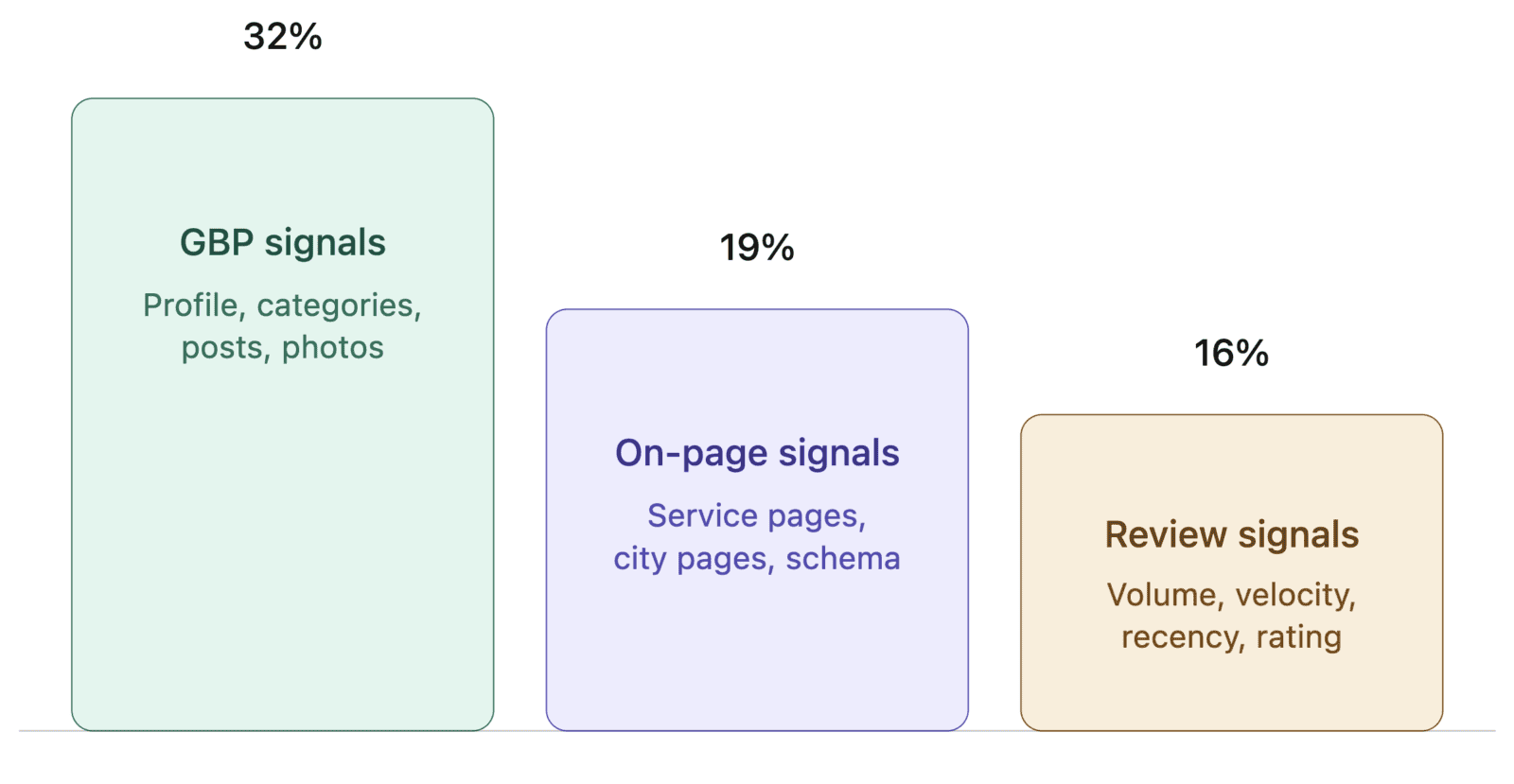
GBP signals account for 32% of local pack ranking weight in 2026 — more than any other single factor. Your primary category, business description, services, photos, and posting activity all feed this signal. An incomplete or inactive profile is a ranking penalty you’re imposing on yourself.
Start here: confirm your primary category is specific. “Roofing Contractor” outperforms “Contractor.” “Electrician” outperforms “Home Services.” Then fill every field, add real project photos weekly, and post at least once per week. Homeowners are using Google Business Profiles more than ever. Your profile needs to be ready when they get there. See how Social Status builds and optimizes Google Business Profiles as part of a full contractor SEO strategy.
2. Reviews — Volume, Velocity, and Recency
Review signals account for 16% of local pack ranking weight — and they’re the primary trust factor that converts a searcher into a caller. 97% of consumers read reviews for local businesses, and businesses with fewer than 10 reviews or a rating below 4.0 face a measurable conversion penalty.
In 2026, Google favors recency and steady velocity over total review count alone. A business with 200 reviews and none in the past six months now ranks below a business with 80 reviews and a steady weekly flow. That’s not a bug — it’s intentional. Fresh reviews signal an active, trusted business. Build the system that generates them consistently, not just after a great job.
Your Google Business Profile is only as strong as the review pipeline behind it.
3. On-Page Signals — Your Website Has to Pull Its Weight
On-page signals account for 19% of local pack ranking weight — and most contractor websites are leaving that entirely on the table. One generic “Services” page does nothing for local SEO. Google needs dedicated pages for each service and each market you serve.
For service-area businesses, individual city pages consistently outperform a single generic “service area” listing. Each page gives Google a dedicated signal for that market. Each page compounds your ranking footprint.
If your site is one page per trade, it’s time to rebuild it for local search. See the website design approach for trades businesses.
What Most Contractors Get Wrong About Local SEO
Most contractors treat local SEO as a setup task. Claim the GBP, fill in the address, add a few photos, and move on. That’s not a strategy — that’s a starting point.
Local SEO is an ongoing system. A profile that stops generating reviews slips, even with a large historical total, because Google reads inactivity as a business that is slowing down. Velocity is the signal, not the total.
The contractors winning the map pack in 2026 are posting weekly, requesting reviews at every job close, updating their service pages, and consistently building local citations. It’s not glamorous. It’s a system — and it compounds.
68% of US Google searches now end without a click, and for local-intent queries that figure is higher still. Your Google Business Profile is the storefront for most local searches. Homeowners search your service, check your reviews, look at your photos, and call the number without ever touching your website. If your profile isn’t optimized, you’re losing jobs before they become leads.
This is exactly what a contractor lead generation engagement diagnoses — what’s working, what’s broken, and what to fix first.
Local SEO for Specific Trades
The fundamentals apply across every trade, but the execution is specific. Here’s what matters by vertical:
HVAC — Seasonal search spikes mean your profile and service pages need to be fully optimized before peak season, not during it. See the HVAC contractor marketing approach.
Roofing — Storm-driven search behavior is hyper-local. City-level service pages and fast review velocity are the primary levers. See the roofing contractor marketing approach.
Electrical — High-intent emergency searches dominate. Profile completeness and review count decide the job at the moment of search. See the electrical contractor strategy.
Plumbing — Same emergency pattern as electrical. Response speed and profile completeness win the job before the website is ever visited. See the plumbing company approach.
Landscaping — Seasonal and project-based. Photo-rich profiles with before and after project images drive disproportionate engagement. See the landscaping company marketing strategy.
Home Remodeling — Longer decision cycles, higher ticket value. Reviews and project galleries carry the most weight. See the home remodeling contractor approach.
Tree Service — Emergency removals and storm response drive the highest-value calls. Map position and response speed decide who gets them, often within the same hour. See the tree service company approach.
Auto Repair — Proximity carries more weight here than in almost any other trade. Map pack position, review volume, and accurate hours are what get a driver in the door. See the auto repair shop approach.
How Long Does Local SEO Take to Work?
Initial improvements from GBP optimization and review generation can be seen within weeks. Ranking improvements in the map pack typically follow 3–6 months of consistent effort. The businesses that dominate local search aren’t the ones who tried hardest for 30 days — they’re the ones who built a system and ran it consistently.
Local SEO compounds. Every review, every post, every optimized page adds to a signal Google keeps scoring. That’s the difference between a tactic and a system.
If you’re not sure where your local SEO stands right now, that’s exactly what a Revenue Map Call surfaces. Social Status audits your Google Business Profile, website, review pipeline, and visibility across your service area, then tells you exactly what to fix first.
You don’t need to rank everywhere. You need to rank where your customers are searching. That’s a system problem — and it’s fixable.
Not sure where your local SEO stands?
A Revenue Map Call identifies exactly where your map pack visibility is breaking down and what to fix first.
Frequently Asked Questions
How do I rank in Google Maps as a contractor?
Google ranks the map pack on relevance, proximity, and prominence. Proximity you cannot control, so the work sits in the other two: a complete and active Google Business Profile with a specific primary category, steady review velocity rather than a large historical total, and dedicated pages on your site for each service and each market you serve. Social Status builds all three as one system, because optimizing any single one in isolation rarely moves position.
What is local SEO for contractors?
Local SEO for contractors is the work of getting a trade business into the Google map pack when homeowners search for its services. It covers Google Business Profile completeness, review velocity, on-page signals, and citation consistency, all working together to produce inbound leads without paid ads. It differs from general SEO because the profile carries more weight than the website.
How long does it take for local SEO to work for a contractor?
Early movement often shows within weeks, because profile corrections and review activity do not depend on ranking. Meaningful map pack position typically takes three to six months of consistent effort. The businesses that dominate local search are not the ones who tried hardest for 30 days — they are the ones who built a system and ran it.
What is the most important factor in Google map pack rankings?
Google Business Profile signals carry the most weight, at roughly 32% of local pack ranking factors, covering primary category selection, completeness, posting activity, and engagement. On-page signals follow at about 19%, and review signals at about 16%. Those three account for roughly two-thirds of what decides your position.
Do contractors need separate pages for each city they serve?
Yes. Individual city or service-area pages consistently outperform a generic “we serve these areas” listing. Each dedicated page gives Google a specific localized signal for that market, expanding your ranking footprint across multiple areas rather than competing for all of them from a single page.
Written by Elena Patrice — Founder and President of Social Status Inc. Since 2018, building local search visibility and growth systems for trades and service businesses ready to scale. Learn more →