
You do better work. Your crews are more experienced. Your materials are higher quality. And yet — a competitor with a rougher finish and a cheaper operation keeps winning bids you should have closed.
It’s not luck. It’s not price. They have a contractor marketing plan; you have a collection of tactics.
What Are Contractor Marketing Systems?
Contractor marketing systems are the connected processes that generate leads, build trust, follow up automatically, and convert inquiries into booked jobs — without relying on you to manually manage each step. They include your Google presence, your website, your review pipeline, your response speed, and how those pieces work together. Most contractors have tactics. Few have systems.
Here’s the pattern that plays out constantly in trades markets: a homeowner searches for a roofing contractor. Three names come up in the map pack. One has 14 reviews and a 4.2 rating. Another has 87 reviews and a 4.8. The homeowner calls the one with 87 reviews first — and never gets to the contractor with better work who shows up third with 14 reviews and no recent photos.
That contractor lost before the call was ever made.
The difference isn’t quality of work. It’s quality of system.
Why the Best Contractor in the Market Isn’t Always the Busiest
Homeowners can’t evaluate your workmanship before they hire you. They can only evaluate what’s visible: your Google Business Profile, your reviews, your response time, and how your website makes them feel. That’s the entire decision-making window. If your marketing system doesn’t perform in that window, your craftsmanship never gets a chance.
The 2007 MIT Sloan Lead Response Management study — six companies, 15,000 leads, 100,000 call attempts — found that contacting a lead within five minutes rather than thirty makes you 21 times more likely to qualify it. That’s not a marginal edge. It’s a different category of business. And 78% of homeowners hire the first contractor who responds.
Most contractors respond when they get off the job site. The contractor with a system responds in minutes — automatically.
97% of consumers read reviews for local businesses, and 41% now say they always do. Your competitor with worse work and 90 more Google reviews isn’t just winning leads — they’re winning trust at scale, before a single conversation happens.
The 4 Systems Gaps That Cost Contractors the Most Jobs
Most contractors don’t have a marketing problem. They have a systems gap — usually in one of these four areas.
1. No Review Generation System
Reviews don’t happen on their own. The contractors dominating local search are asking every single customer at the close of the job — automatically, by text or email. The contractors with the best review profiles usually aren’t the best contractors. They’re the ones who ask the most. If you’re not asking systematically, you’re losing ground every week.
Your Google Business Profile is only as strong as the review cadence behind it.
2. No Lead Response System
A lead that doesn’t get a response in the first hour is a lead that’s already talking to someone else. Automated qualification can cut average response time from hours to under a minute, and you don’t need to be a tech company to implement it. You need a CRM, an auto-response, and a follow-up sequence. That’s the system.
3. No Visibility System
Visibility isn’t a one-time task. It’s an ongoing system — Google Business Profile updates, weekly posts, fresh photos, optimized service pages, and consistent local signals. The map pack captures roughly 42% of clicks on a local search results page. If you’re not appearing there consistently, your competitors are. See how Social Status approaches contractor SEO and visibility.
4. No Follow-Up System
Most contractors give up after one or two attempts on a cold lead. The best contractor marketing systems follow up five to seven times across multiple channels — text, email, voicemail — before moving on. The job you quoted last month that went quiet? It may not be gone. It may just be waiting for a system that follows through.
Systems vs. Tactics: Why the Difference Matters
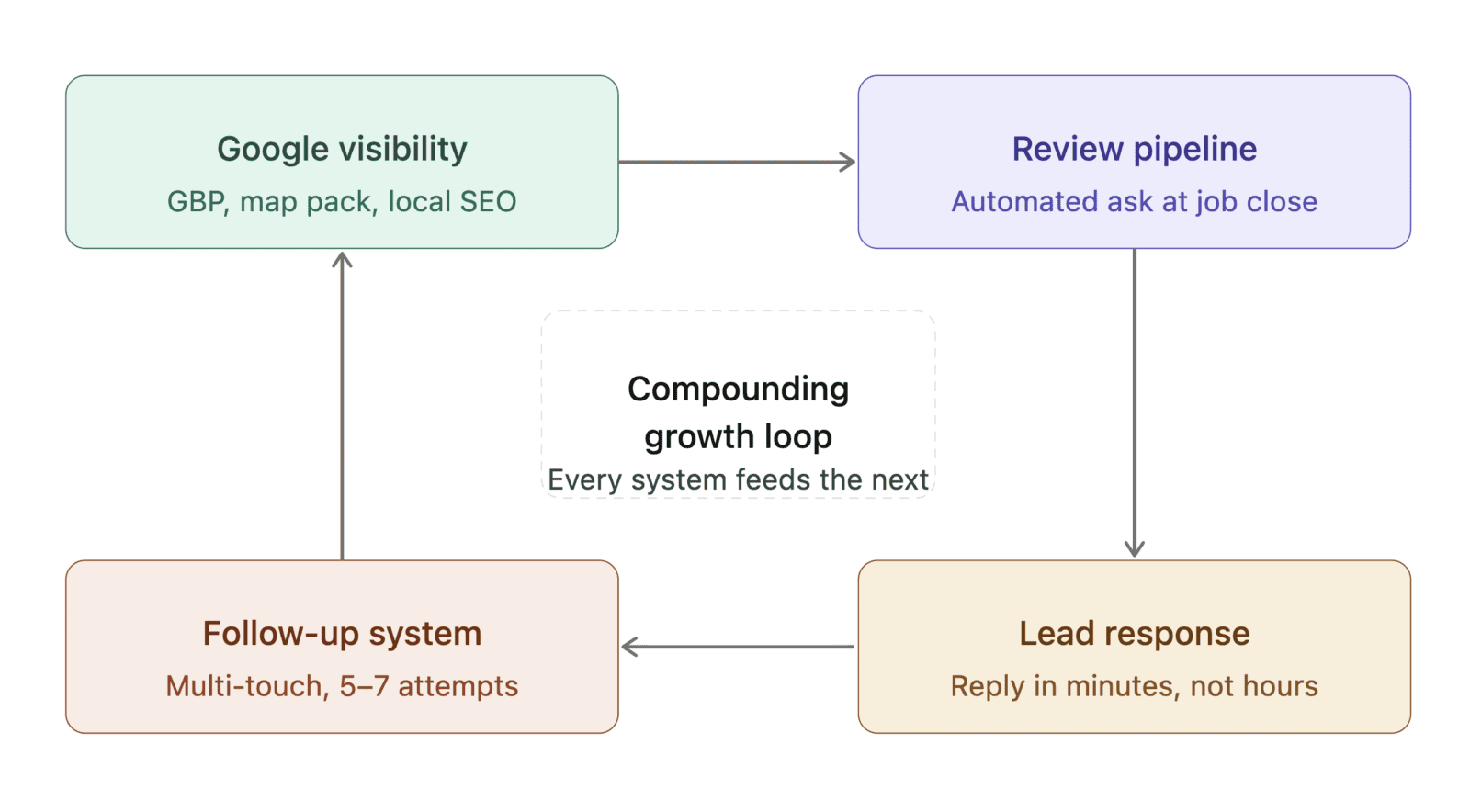
A tactic is posting a before-and-after photo. A system is a review request that goes out automatically two days after job completion, feeds your Google Business Profile, and gets cited by AI search when a homeowner asks which roofer to call.
Tactics produce spikes. Systems produce pipelines.
Contractors who track what actually produces booked jobs outgrow the ones who don’t. That gap isn’t better work. It’s better visibility into what’s working, and the discipline to build on it. That’s a systems mindset.
Most trade businesses between $500K and $2M in revenue run on word of mouth, sporadic ad spend, and one solid referral source. That works until it stops. A marketing system makes growth repeatable regardless of how busy you are — which is exactly what Social Status builds inside contractor lead generation engagements.
What Contractor Marketing Systems Look Like in Practice
Here’s what a functioning contractor marketing system actually includes — not as a wish list, but as a working machine:
Google Business Profile — fully optimized, updated weekly with photos and posts, review requests automated at job close. This is your highest-ROI local asset. If it’s sitting idle, you’re handing leads to competitors.
Website — built to convert, not just to exist. Clear service pages, load speed under 2 seconds, mobile-first, with calls to action above the fold. A website that doesn’t convert is an expense, not an asset. See the website design approach for trades businesses.
CRM with lead response automation — every inquiry routed, logged, and auto-responded to within minutes. No lead falls through because you were on a roof.
Review pipeline — systematic asks at every job close, not just when you remember. This is what builds the review count that makes you the obvious choice in the map pack.
Follow-up sequences — multi-touch, multi-channel. Quotes that go cold get followed up on. Jobs that were postponed get a check-in 30 days later.
None of this is complicated. All of it requires intention. The difference between the contractor winning the market and the one wondering why the phone slowed down is usually one of these systems — either missing or broken.
How to Start Building Your Marketing System
Start with the gap that’s costing you the most right now. For most contractors, that’s either review generation or lead response speed. Fix one. Systematize it. Then layer in the next.
If you’re operating at $500K or above and you’re not sure where your biggest gap is, that’s exactly what a Revenue Map Call surfaces. Social Status reviews your current lead sources, your Google presence, your response infrastructure, and your conversion rate, then tells you exactly where you’re losing jobs you should be winning.
You don’t lose jobs to worse contractors because the market is broken. You lose them because they’ve built something you haven’t yet. That’s fixable.
Ready to find out where you’re losing jobs?
A Revenue Map Call identifies exactly which system gaps are costing you revenue and what to fix first.
Frequently Asked Questions
What is a contractor marketing system?
A contractor marketing system is a set of connected processes—Google presence, review generation, lead response, follow-up sequences, and tracking—that bring in leads and convert them to booked jobs without relying on manual effort at every step. The distinction from tactics is repeatability: a tactic produces a spike; a system produces a pipeline. Social Status builds them as one connected loop rather than separate projects.
Why do contractors with worse work sometimes win more jobs?
Because homeowners cannot evaluate workmanship before hiring. They evaluate reviews, response speed, online visibility, and professionalism — the only things visible in the decision window. A competitor with more reviews and faster follow-up wins bids regardless of skill level, which means the better contractor without a system loses by default.
How many reviews does a contractor need to be competitive?
There is no universal threshold, but in most local markets, 50 or more Google reviews with a 4.5+ rating puts you in a competitive position in the map pack. Consistency matters more than the total. New reviews arriving regularly signal an active, trusted business to both Google and homeowners, while a large historical count with nothing recent reads as a business that has slowed down.
What is the most important part of contractor marketing in 2026?
Speed and visibility. The MIT Lead Response Management study found that contacting a lead within five minutes rather than thirty makes you 21 times more likely to qualify it. Paired with a strong Google Business Profile and consistent reviews, response speed is the fastest lever for winning more jobs from the same lead volume you already have.
How do I know which marketing system to fix first?
Start with your Google Business Profile and review pipeline. Both are visible to every potential customer before they contact you, so if either is weak, every other marketing investment underperforms. Once those are solid, address lead response speed and follow-up automation, in that order.
Written by Elena Patrice — Founder and President of Social Status Inc. Since 2018, building local search visibility and growth systems for trades and service businesses ready to scale. Learn more →