
Landscaping companies get clients four ways: a Google Business Profile full of real project photos, project pages that let homeowners see the work before they call, reviews that name the job, and direct outreach to property managers for commercial work. The companies that grow fastest also decide which client they want before spending a dollar, because a weekly mowing account and a $40,000 patio are found in completely different places.
Get that choice wrong, and the marketing works perfectly. It just fills the schedule with the wrong jobs.
What a landscaping lead costs in 2026
Landscaping leads are cheaper than most trades. 99 Calls’ Google Ads data for January through July 2026, covering 1,928 landscaping leads, put the monthly median at $56 to $66 per lead, and the number barely moved: a $10 spread across seven months. Top-performing campaigns ran $30 to $56.
Google Local Services Ads land in the same range. As of September 2026, 99 Calls reports landscaping LSA leads averaging $59.24, with most between $50.05 and $65.70. That figure comes from only three campaigns, so treat it as a planning number, not a benchmark.
The cheap lead is not the whole story. A $60 lead for a one-time cleanup and a $60 lead for a design-build project are completely different purchases. That is why the next decision comes before any spend.
Decide which client you are trying to win
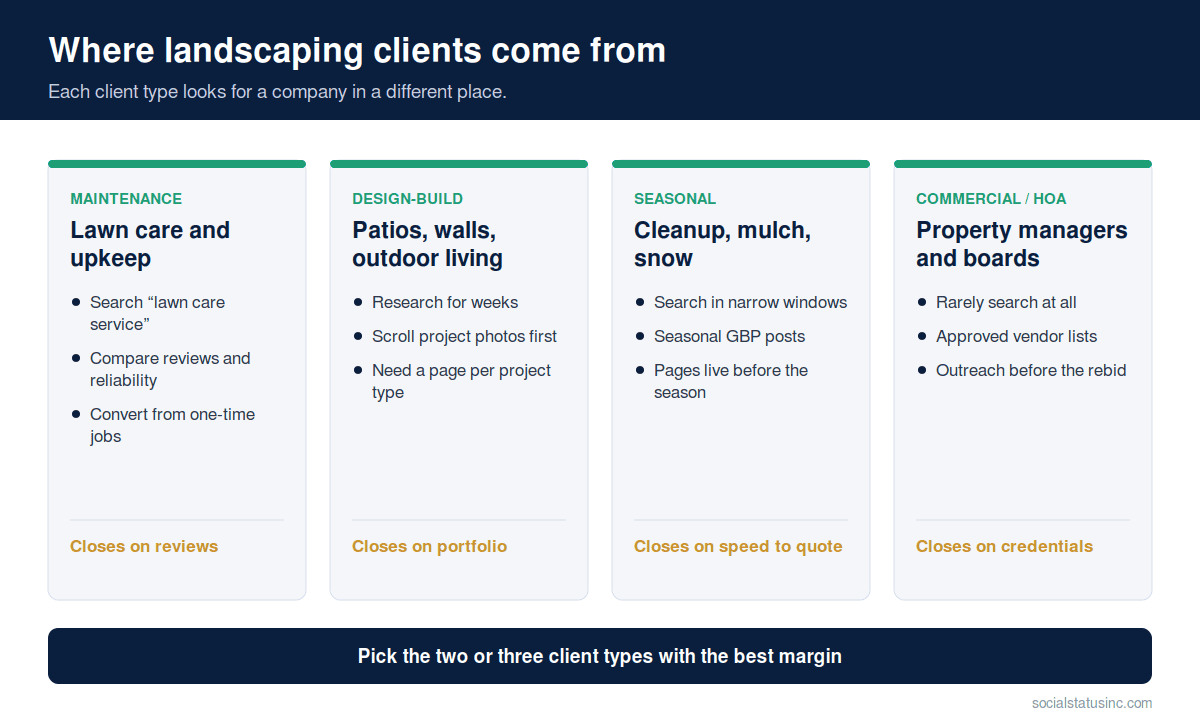
Landscaping has at least four client types, and each one looks for a company differently:
- Maintenance clients search “lawn care service” and “landscape maintenance” and choose on reviews, reliability, and price.
- Design-build and hardscape clients search “patio installation,” “retaining wall contractor,” and “landscape design,” research for weeks, and choose based on portfolio.
- Seasonal clients search for fall cleanup, mulching, leaf removal, and snow removal in narrow windows.
- Commercial and HOA clients mostly don’t search at all. You reach them through vendor lists and relationships.
Most landscaping companies market to all four with the same homepage. The fix is a dedicated page, profile category, and review stream for the two or three client types that carry the best margin, and less effort on the rest.
Your Google Business Profile is a portfolio
In landscaping, the profile does more selling than in almost any other trade, because the product is visual. Homeowners scroll photos before they read a word.
Set the primary category to match the work you want most, such as Landscaper or Landscape Designer for design-build and Lawn Care Service for maintenance, then add secondary categories for every service you actually perform. Fill the Services section with a description for each. Post finished projects weekly with the service named in the caption. The five profile gaps that suppress contractor visibility cover the rest of the audit.
Photos need to be real. Stock images of a perfect lawn sell nothing and teach homeowners to scroll past the listing.
Project pages close design-build work
A homeowner planning a $30,000 outdoor living project will not call from a Services page with three bullet points. They want to see finished work like theirs, understand the process, and get a rough sense of cost before the first conversation.
Build one page per project type: patios, retaining walls, outdoor kitchens, planting design. Each includes before-and-after photos, a short job description, a typical timeline, and a clear way to request a consultation. Those pages rank for research searches and pre-qualify budgets before the estimate visit. Why most contractor websites don’t generate leads covers the structure in detail.
How to get commercial landscaping contracts
Commercial work runs on a different motion. Property managers, HOA boards, and facilities directors rarely search for a landscaper. They keep approved vendor lists and rebid grounds contracts on a calendar, often in late winter ahead of spring.
Getting on those lists takes three things. First, a commercial page that speaks to their concerns: crew capacity, insurance limits, reporting, and response time on service requests. Second, credentials that are easy to verify, with certificates of insurance ready to send, licenses, and references from existing commercial accounts. Third, direct outreach to property management firms in the service area, timed before the rebid window rather than during it.
One commercial account can equal dozens of residential maintenance clients and runs for years with no marketing cost attached. The landscaping industry page covers how Social Status builds that positioning alongside residential work.
Reviews that name the job
Landscaping reviews do double duty. They help the profile rank, and they tell a prospect exactly what the company is good at. “Built our paver patio and fire pit in eight days and left the yard cleaner than they found it” sells design-build. “Great guys” sells nothing.
Ask at the final walkthrough, while the client is standing in the finished yard. Text the direct review link before the crew pulls away, follow up once at 48 hours, and respond to every review. Steady velocity, a few new reviews every week, beats a large total that stopped growing. The full review system is here.
Quote fast, then keep following up
In landscaping, the first company to deliver a clear estimate often wins, because homeowners collecting three quotes rarely wait for the third. Leads contacted within five minutes are roughly 21 times more likely to qualify than leads contacted at 30 minutes, per the Lead Response Management study of more than 15,000 leads.
Crews in the field cannot answer phones, so the system needs to handle missed calls with text-back, a short estimate request form that accepts photos, and a follow-up sequence on every open estimate at day 2, day 7, and day 21. Design-build estimates in particular go quiet for weeks while homeowners think it over. The company that is still in touch when they decide gets the job.
Turn one-time jobs into recurring revenue
Every cleanup, install, and one-time mow is an audition for a maintenance agreement. Offer one at the end of every job, in writing, with a price and a start date. A client on a season-long agreement stops being a lead cost and becomes a revenue base that carries the business through the slow months.
Track the source of every signed client
Record where every signed client came from for 90 days. Not every lead. Every signed client. Then divide each channel’s spend by the clients it produced. Owners are usually surprised: one source produces design-build work at a fraction of the cost of another, and at least one line item bills monthly and produces almost nothing. The channel comparison by cost per booked job lays out paid versus owned sources.
See how your landscaping company shows up locally
The Pinned Local diagnostic scores your Google Business Profile and local search presence across five phases in about five minutes, then returns your score and ranked priority actions. No credit card and no sales call.
Frequently Asked Questions
How much does a landscaping lead cost in 2026?
A landscaping lead costs roughly $56 to $66 through Google Ads and about $59 through Google Local Services Ads in 2026. The Google Ads range is the monthly median from 99 Calls’ January–July 2026 data across 1,928 landscaping leads, with top campaigns at $30 to $56. The LSA average of $59.24 comes from a small sample of three campaigns as of September 2026, so it works as a planning figure rather than a firm benchmark.
How do I get on a property manager’s landscaping vendor list?
A landscaping company gets on a property manager’s vendor list by contacting the management firm directly before the contract rebid window, with insurance certificates, licenses, and commercial references ready to send. Many firms rebid grounds contracts in late winter ahead of spring, so outreach in fall and early winter lands before decisions are made. A commercial page covering crew capacity, insurance limits, and service-request response time gives the property manager something to forward to the board.
What should a landscaping company post on its Google Business Profile?
A landscaping company should post photos of finished projects every week, with the service named in the caption. Before-and-after patio, retaining wall, planting, and cleanup pairs show the range of work, and seasonal posts about fall cleanup, spring mulching, or snow removal match what homeowners search that month. Social Status recommends real crew and project photos only, because stock images give a prospect no evidence the company did the work.
How fast should a landscaper send an estimate?
A landscaper should respond to an estimate request within five minutes and deliver the written estimate within one to two business days. Leads contacted within five minutes are roughly 21 times more likely to qualify than leads contacted at 30 minutes, per the Lead Response Management study of more than 15,000 leads. Social Status sets up missed-call text-back and a follow-up sequence at day 2, day 7, and day 21, so open estimates keep getting contact while crews are in the field.
Written by Elena Patrice — Founder and President of Social Status Inc. Since 2018, building local search visibility and growth systems for trades and service businesses ready to scale. Learn more →