
HVAC companies get more leads by fixing four things in order: showing up in the map results for every job type they do, winning the homeowner with recent reviews that name the work, answering inside five minutes, and working the customer list they already own. Buying more ads is the fifth move, not the first. Most shops run that list backwards and pay for it every July.
The reason is arithmetic. A paid lead costs the same on day 400 as it did on day one. Everything else on that list gets cheaper the longer it runs.
What an HVAC lead costs in 2026
Start with real numbers, because the gap between channels is wider than most owners assume.
Google Local Services Ads are the cheapest paid source for HVAC right now. SearchLight Digital’s February 2026 benchmark, covering 888 contractors and 126,650 leads, put HVAC LSA leads at $51 on average, with the highest closed return of any trade in the dataset at 9.55x.
Standard Google Ads split sharply by who is searching. SearchLight’s January 2026 HVAC and plumbing benchmark, built on $14.9M in spend across 816 contractors, found branded search leads at $34, Performance Max at $72, and non-branded search at $149. Other agency datasets put non-branded HVAC leads well above that in competitive markets, so base your budget on your own numbers.
Read that split carefully. A lead from someone who already knows your company name costs less than a quarter of a lead from someone who doesn’t. Every review, every truck on the road, every service call that ends well moves future searches out of the $149 column and into the $34 column. That is the case for owned marketing in one paragraph.
Show up for every job you actually do
HVAC demand splits into dozens of separate searches: AC repair, furnace replacement, heat pump installation, ductless mini-splits, tune-ups, indoor air quality. A company with one category and a single Services page can only appear for a fraction of them.
The Google Business Profile carries most of that weight. Primary category: HVAC Contractor, then add every secondary category that matches work the company actually performs, then fill the Services section with a description for each job type. Google’s local AI answers pull from the profile, not the website, so an empty services list means the company does not appear in those answers at all. The five profile gaps that suppress contractor visibility are covered in the full audit.
The website backs it up with one page per job type. Replacement pages matter most. A replacement ticket is worth many repair tickets, and homeowners research it for days before calling. A page that covers cost range, install timeline, efficiency options, and financing in plain language catches that research. A generic Services page never will.
Build for planned work, not just emergencies
Emergency calls come to everyone when it’s 98 degrees. The companies with steady schedules also rank for the searches nobody makes in a panic: tune-up, system age check, replacement cost, heat pump rebates, duct cleaning. Those searches are less competitive, and they happen in the months when the phone is quiet.
The catch is timing. Local visibility takes months to build, so the spring tune-up page has to be live and indexed by winter. The HVAC industry page covers how Social Status plans that calendar around the shoulder seasons.
Reviews close the call before you pick up
A homeowner choosing between three HVAC companies reads reviews before comparing price, because letting a stranger into the attic is a trust decision. Two things matter more than the total count.
Recency is the first. A profile that collected 40 reviews in a burst two years ago looks dormant next to one adding two to five every week.
Content is the second. “Replaced our 18-year-old heat pump in one day, right before the cold snap” tells Google, and every AI assistant reading the profile, what the company does and how fast. “Great service” tells them nothing. Ask at job close, text the direct review link while the tech is still in the driveway, and follow up once. The full review system is here.
Answer in five minutes or stop paying for leads
Leads contacted within five minutes are roughly 21 times more likely to qualify than leads contacted at 30 minutes, per the Lead Response Management study of more than 15,000 leads. In HVAC, the window is tighter still, because a homeowner with no heat calls the next number on the list almost immediately.
Techs on a roof cannot answer the phone. That makes response a system requirement, not a staffing excuse: missed-call text-back that fires in seconds, an after-hours answering service that books or dispatches instead of taking messages, and an estimate follow-up sequence that runs on day 2, day 7, and day 21 without anyone remembering. An install estimate that never gets a second contact is the most expensive lead in the business, because the money to get it is already spent.
Your best replacement leads are already in your service history
Most HVAC companies sit on a lead list worth more than their ad budget and never open it.
Every service call records equipment age. Pull every customer with a system 12 years or older, and that list is next season’s replacement pipeline: homeowners who already trust the company, already know the tech’s name, and are one bad repair away from a new system. A short, specific message beats a coupon. Name the unit’s age, what the last visit found, and offer a replacement estimate before the season turns.
Maintenance agreement members are the same list with better odds. They see a tech twice a year, so the replacement conversation happens in person, from someone they already let into the house. That makes agreement count a lead generation number, not just a recurring revenue number.
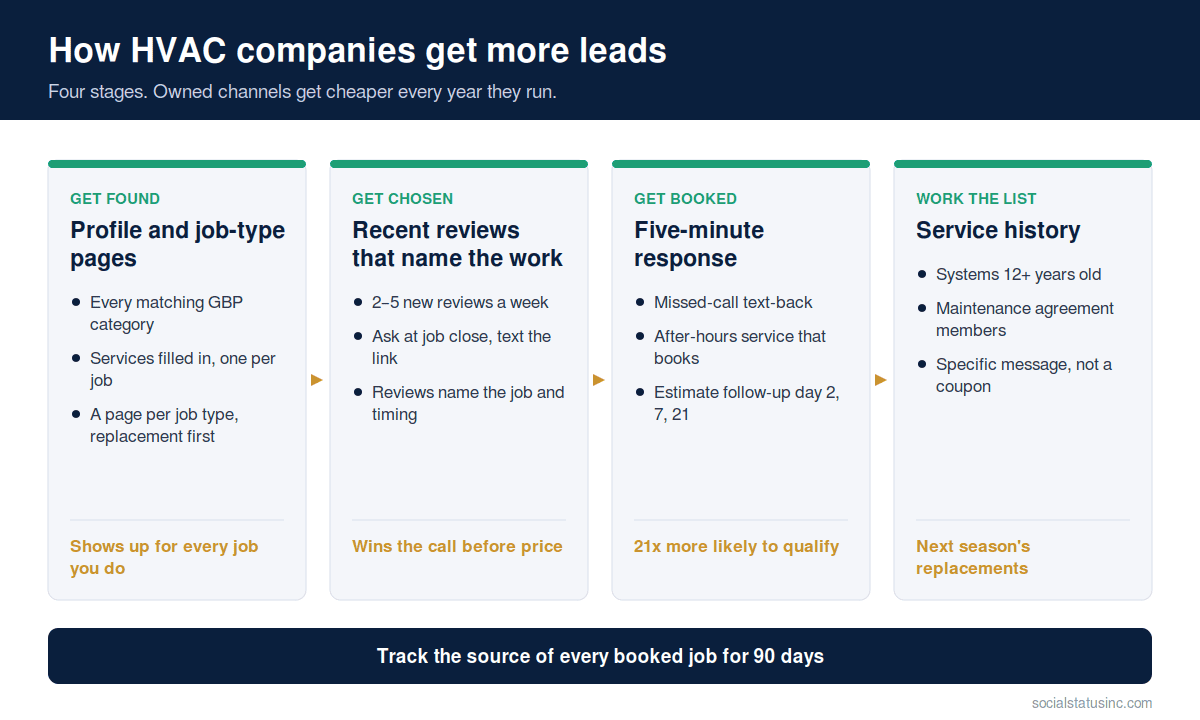
Track the source of every booked job
None of this becomes a decision until each booked job has a source attached. Not each lead. Each booked job. Run it for 90 days, divide each channel’s spend by the jobs it produced, and the budget answers itself.
Owners doing this for the first time usually find the same pattern: repeat customers and branded searches producing jobs at a fraction of the cost of non-branded ads, and at least one line item billing every month while producing almost nothing. The channel comparison by cost per booked job shows how paid and owned sources stack up.
Where to start
If the phone is slower than it should be, check these in order: profile categories and services, review recency, response time, then the service-history list. Most HVAC companies find their biggest gap in the first two, and both cost nothing but time to fix.
See how your HVAC company shows up locally
The Pinned Local diagnostic scores your Google Business Profile and local search presence across five phases in about five minutes, then returns your score and ranked priority actions. No credit card and no sales call.
Frequently Asked Questions
How much does an HVAC lead cost in 2026?
An HVAC lead costs about $51 through Google Local Services Ads and $34 to $149 through standard Google Ads, depending on whether the searcher already knows the company name. Those figures come from SearchLight Digital’s 2026 benchmarks: the LSA average from February 2026 across 888 contractors, and the Google Ads split from January 2026 across 816 HVAC and plumbing contractors, where branded search ran $34, Performance Max $72, and non-branded search $149. Cost per booked job is the more useful number, because close rates differ widely by channel.
What is the fastest way to get more HVAC leads?
The fastest way to get more HVAC leads is to answer every call and form within five minutes, because most companies are already losing leads they paid for. Leads contacted within five minutes are roughly 21 times more likely to qualify than leads contacted at 30 minutes, per the Lead Response Management study of more than 15,000 leads. Missed-call text-back and an after-hours answering service can be running within a week, and Google Local Services Ads can add paid volume within days of approval.
How do HVAC companies turn service calls into replacement leads?
HVAC companies turn service calls into replacement leads by pulling every customer with a system 12 years or older from their service records and contacting them before peak season. The message works best when it is specific: the unit’s age, what the last visit found, and an offer for a replacement estimate. Social Status builds these follow-up sequences from service history so the list gets worked every spring and fall instead of sitting in the software.
Should an HVAC company buy leads from Angi or HomeAdvisor?
An HVAC company should use Angi or HomeAdvisor only as a short-term fill, because those leads are shared with several contractors at once. Shared leads force a race on speed and price, which lowers close rates and pushes the real cost per booked job above exclusive channels like Google Local Services Ads at about $51 per lead. Social Status recommends tracking booked jobs by source for 90 days before renewing any marketplace spend.
Written by Elena Patrice — Founder and President of Social Status Inc. Since 2018, building local search visibility and growth systems for trades and service businesses ready to scale. Learn more →